
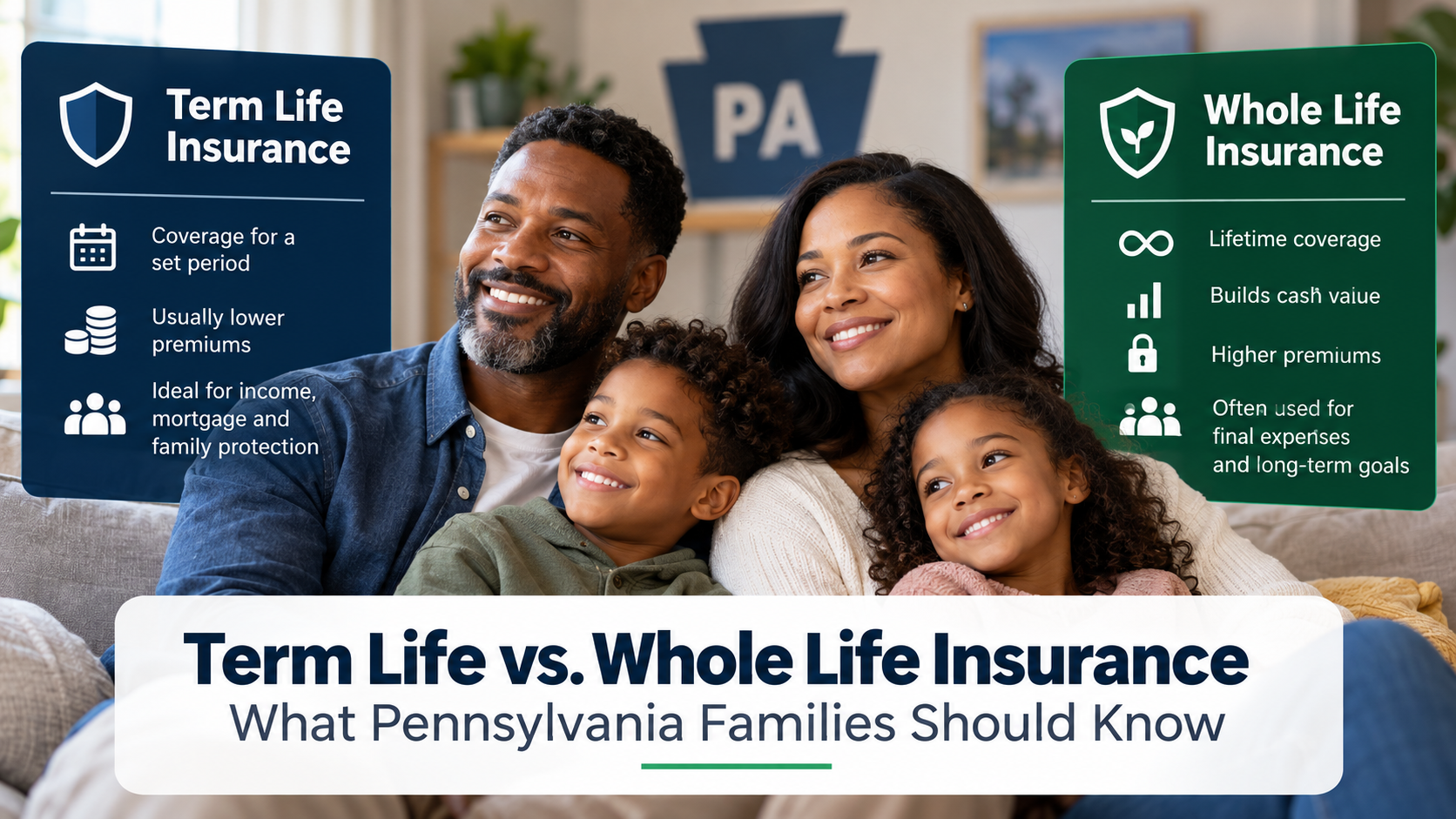
Choosing between term life vs. whole life insurance in Pennsylvania can feel complicated, especially when both types of coverage are designed to accomplish the same basic goal: providing financial protection for the people you care about.
The major difference is how long the coverage is designed to last, how premiums work, and whether the policy includes features beyond a death benefit.
Neither type of life insurance is automatically better. The right choice depends on your financial responsibilities, budget, age, family situation, and what you want the insurance to accomplish.
Understanding the differences can make it much easier to decide which type of coverage deserves a closer look.
What Is Term Life Insurance?
Term life insurance provides coverage for a specified period of time.
Common policy terms may include 10, 20, or 30 years, although available options vary by insurance company.
If the insured person dies while the policy is in force during the covered term, the insurer generally pays the death benefit to the named beneficiary according to the policy’s terms.
If the term ends while the insured person is still living, the coverage may end unless the policy provides an option to renew or convert it.
Because term insurance is designed primarily to provide a death benefit for a limited period, it can often provide a larger amount of coverage for a lower initial premium than permanent life insurance.
Why Do People Buy Term Life Insurance?
Term life insurance can make sense when someone has a large financial responsibility that won’t necessarily last forever.
For example, a Pennsylvania family might want coverage while:
- Children are financially dependent on their parents
- A mortgage is being paid
- A spouse depends on the insured person’s income
- College expenses are approaching
- Business or personal debts remain outstanding
Imagine a 35-year-old parent with young children and a mortgage.
That person may need substantial life insurance protection today but expect those financial obligations to be much smaller 20 or 30 years from now.
A term policy can be designed around that period of greatest financial need.
What Is Whole Life Insurance?
Whole life insurance is a form of permanent life insurance.
Instead of providing coverage for a specified number of years, a whole life policy is generally designed to remain in force for the insured person’s lifetime as long as required premiums are paid and the policy remains in force.
Whole life policies can also build cash value over time.
Part of the premium helps fund the policy’s insurance protection, while the policy may accumulate cash value according to its terms.
Because whole life insurance provides permanent coverage and additional policy features, premiums are generally higher than those for comparable amounts of term life insurance.
Why Do People Buy Whole Life Insurance?
Whole life insurance may appeal to someone who wants coverage that isn’t designed to expire after a certain number of years.
Potential uses can include:
- Providing a death benefit regardless of when death occurs, subject to policy terms
- Helping with final expenses
- Leaving money to beneficiaries
- Providing permanent insurance protection
- Building cash value within the policy
Whole life insurance can also be used for smaller policies designed primarily around funeral expenses and other final obligations.
That’s one reason final expense insurance is often structured as a form of whole life insurance.
Term Life vs. Whole Life Insurance in Pennsylvania
The easiest way to understand the difference is to compare their basic characteristics.
| Term Life Insurance | Whole Life Insurance | |
|---|---|---|
| Coverage period | Specific term | Generally lifetime |
| Initial premium | Usually lower | Usually higher |
| Death benefit | Yes | Yes |
| Cash value | Generally no | Yes |
| Designed to expire | Yes | Generally no |
| Common use | Income/mortgage/family protection | Permanent needs/final expenses/legacy |
| Complexity | Generally simpler | Additional policy features |
The right choice isn’t determined by which column has more benefits.
It’s determined by which features actually solve your financial problem.
Is Term Life Insurance Cheaper Than Whole Life Insurance?
For comparable applicants and death benefits, term life insurance generally has a lower initial premium than whole life insurance.
That’s largely because the insurer is providing coverage for a specified period rather than permanent coverage with a cash-value component.
That can make term insurance attractive to families who need a relatively large amount of protection while staying within a monthly budget.
However, price shouldn’t be the only consideration.
A lower premium isn’t necessarily better if the coverage ends before the need for insurance does.
Likewise, paying substantially more for permanent coverage may not make sense if your primary need only exists for a limited period.
Does Whole Life Insurance Build Cash Value?
Whole life insurance generally includes a cash-value component that can accumulate over time according to the policy’s terms.
Policyowners may have options for accessing cash value while the policy is in force.
However, accessing policy value through withdrawals or loans can affect the policy’s cash value and death benefit and may have other consequences.
For that reason, consumers shouldn’t choose whole life insurance simply because they’ve heard that it is an “investment.”
It’s first and foremost a life insurance contract.
The guarantees, costs, cash-value structure, and other features should be understood before purchasing the policy.
Consumers can also review the NAIC’s life insurance consumer guidance to learn more about comparing life insurance policies and understanding policy features.
Which Is Better for Young Pennsylvania Families?
For many younger families, the biggest financial risk is losing an income while substantial financial responsibilities still exist.
Consider parents with:
- Young children
- A mortgage
- Car payments
- Household expenses
- Future education expenses
- Limited savings
They may need hundreds of thousands of dollars of life insurance protection but may not have the budget for the same death benefit through permanent insurance.
Term life insurance can potentially provide a larger death benefit during the years when that protection is most important.
That doesn’t mean every young family should buy term insurance. It means the structure of term insurance often aligns well with temporary but substantial financial obligations.
Which Is Better for Someone Concerned About Final Expenses?
Someone whose primary concern is leaving money for funeral expenses, final bills, or other end-of-life costs may have a different need.
They may not require a large death benefit intended to replace decades of income.
A smaller permanent policy may make more sense because the objective is to have coverage available whenever death occurs rather than during a particular 20- or 30-year period.
If that’s your primary concern, our guide to final expense insurance in Pennsylvania explains how that type of coverage works in greater detail.
Can You Have Both Term and Whole Life Insurance?
Yes.
Life insurance doesn’t necessarily have to be an either/or decision.
Some people use multiple policies for different purposes.
For example, someone might maintain a permanent policy intended to provide lifelong protection while also purchasing a larger term policy during the years when children are young and a mortgage remains substantial.
As those temporary financial obligations decline, the term coverage may eventually no longer be needed.
This approach is sometimes called layering coverage.
Whether it makes sense depends on the person’s needs and budget.
What Happens When Term Life Insurance Ends?
This is an important question to ask before purchasing term coverage.
Depending on the policy, you may have several possibilities when the initial term ends.
The policy may simply expire, provide an opportunity for renewal at a higher premium, or include a conversion option that allows some or all of the coverage to be converted to permanent life insurance.
Those provisions vary by policy and insurer.
If convertibility is important to you, understand the conversion rules and deadlines before purchasing the policy rather than assuming you’ll have that option later.
Questions to Ask Before Choosing Life Insurance
Before deciding between term life vs. whole life insurance in Pennsylvania, consider:
- How much money would my family need if I died?
- How many years would they need financial support?
- Do I have children or other dependents?
- How much debt would I leave behind?
- Do I want temporary or permanent coverage?
- Is building policy cash value important to me?
- What premium can I comfortably maintain?
- Do I already have life insurance through my employer?
- Could my insurance needs change substantially in the future?
Those questions are usually more useful than simply asking, “Which policy is better?”
How Much Life Insurance Do You Need?
The appropriate amount varies significantly from person to person.
Someone primarily concerned about final expenses may need a much smaller death benefit than a parent trying to replace income and protect a family for 20 years.
Consider your income, debts, mortgage, dependents, existing savings, current insurance, and future financial obligations.
Life insurance should be based on the financial gap your death would create, not an arbitrary coverage amount.
Comparing Life Insurance Options in Pennsylvania
When comparing term life vs. whole life insurance in Pennsylvania, don’t focus exclusively on premium.
Consider:
- Coverage amount
- Length of coverage
- Premium guarantees
- Underwriting requirements
- Conversion options
- Cash-value features
- Policy exclusions and limitations
- The financial need you’re trying to address
Insurance products and underwriting requirements vary between companies, so comparing available options can be valuable.
A licensed insurance professional can help you understand those differences before you apply.
Get Help Choosing Life Insurance in Pennsylvania
Life insurance should fit your life rather than forcing your financial needs into a particular product.
For some Pennsylvania families, affordable term coverage may provide the protection they need during their highest-responsibility years.
For others, permanent coverage may better address lifelong needs, final expenses, or legacy goals.
And for some people, a combination of both may make sense.
Keystone Coverage Advisors helps Pennsylvania individuals and families understand their life insurance options and compare coverage based on their needs, goals, and budget.
If you’re considering life insurance, we’re here to help you understand your options before you make a decision.